

How Black Flag Perfectly Balanced Being A Pirate & Assassin Game
Breakdown
When Assassin’s Creed IV Black Flag released in October 2013, the game instantly revolutionised the pirate genre, and managed to perfectly blend being a standard Assassin’s Creed game, as well as a fun pirate adventure game on its own. Ubisoft successfully managed to mix these two seemingly unmatchable elements - Pirates and Assassins - but Ubisoft worked their storytelling magic, and combined the two into one strong and memorable adventure that was both a great Assassin’s Creed game, as well as a great pirate game, making for what many fans consider the best game in the entire series. Being something to have been executed in a less sharp, and or critique heavy manner in newer instalments - the Spartan, Viking and Samurai aspects of Odyssey, Valhalla and Shadows - how did Black Flag manage to blend being an Assassin and Pirate game so well, also in hindsight? We will be exploring this in this special Assassin’s Creed Black Flag - Resynced release day article. Let’s dive into it!

With said highly anticipated release of Assassin’s Creed Black Flag - Resynced, fans have once again been reminded of how special and unique the original game was. After the official announcement of the original over a decade ago, fans were understandably skeptical, if the Assassin’s Creed series could ever mix with the Golden Age of Piracy. There were countless fans who simply were not sold on the idea, but Ubisoft brought their best and ended up surprising tons of people. The game does a good job not trying to do too much of either of these aspects. It does not overdo the pirate themes, nor does it overdo the lore of the Assassins’ Brotherhood. It managed to blend both so perfectly, that it created a rare balanced game, that from a narrative standpoint, managed to offer both a healthy dose of each of its major aspects, while not giving away too much of either.
The concept of naval combat in an AC game, did really begin in 2012’s Assassin’s Creed III, where players saw Revolutionary America through the eyes of the son and grandson - Haytham Kenway & Ratonhnhaké:ton - of Edward, giving players an introduction to naval combat, featured in select main and side missions of the game, players captaining the Aquila. Fans who played the game, wisely anticipated the next game in the series to further expand on naval combat, as it was a big hit already, despite being a small part of the game. It was a concept that simply had to be explored further. Many players were then not surprised to hear, that the next game would be a fully fledged pirate adventure, taking us to the latter days of the Golden Age of Piracy in the Caribbean. Fan feedback was mixed at the announcement, as many fans understood the strong lore of the franchise, and how it could relate to pirates, did not seem to add up at first.
At the core of it, the game had a very strong story, which centred around the transformation of Edward Kenway, going from a self-centred, brash young pirate, to honourable Assassin. The most interesting part of the story, was for the majority of the game, Edward seemingly resents and mocks the Brotherhood, loosely only aiding them if it benefits himself. Ubisoft clearly knew that this could annoy dedicated fans, who understood how important the Brotherhood is to the franchise. Towards the end though, the story takes a sharp turn, Edward having lost everyone and everything, redeeming himself and turning his life around, now fully serving and aiding the Assassins. It was a gamble from the developers at Ubisoft, who knew they had to approach the story in the proper way, otherwise they could lose the trust of their most dedicated fans. Thankfully, they aced their assignment, and the game turned into not just one of the best Assassin’s Creed games, but one of the most iconic games of the ‘10’s overall.
In terms of blending the Pirate and Assassin elements, if anything, the pirate elements perhaps also mostly came across in the open world, as well as few select parts of the story, rather than being the main focal point. In Sequence 3, the player is taught in boarding ships and other basics of piracy - Edward Kenway just having acquired his own ship in the form of the Jackdaw, being taught by Benjamin Hornigold - and Sequences 6 & 7 centre around the fall of the pirate republic of Nassau. Other than that, the game’s story as said does mostly centre around Edward’s personal journey, pursuing wealth in finding the mysterious “Observatory”, piracy being a mere mean to that, and his redemption aiding and joining the Assassins, whom he have also crossed paths with given his pirate journey. Compared to say the Viking narrative of Valhalla, the whole pirate element and narrative, is really mostly there to support the story of the game’s protagonist, as well as the part of the story that as true as can be centres around the Assassins.
The game properly balanced naval combat, open world exploration and story, nothing being overshadowed. It still feels like an adventure on the Caribbean sea, as well as a top tier Assassin’s Creed game. The story also does a good job sneaking hints and mentions of the Assassins into the game early on, such as (from Edward’s perspective unknowingly) working against and with the Brotherhood, to acquiring hidden blades, both the Assassin and Templar Orders being major parts of the story and more, just like most other classic games in the series. The game arguably spends more time focusing on the Templars - at least early on - and Edward’s place in the Assassin/Templar war, impersonating a turncoating Assassin, making for introductions to Templar Grandmaster Laureano Torres and his associates Woodes Rogers and Julien Du Casse. The true reality of the Assassins is not actually fully explored until a fair amount of hours into the game in Sequence 4. The game did an excellent job focusing on the main two factions, while still giving players the freedom to explore as a pirate.
The combat of the game certainly uses a blend of both a typical Assassin’s Creed game and old fashioned pirate fights. The game very early on introduces the famous hidden blade weapon, and you are able to use it freely. The hidden blade can be used alongside usual pirate weapons like dual swords and flintlock pistols. The fact that you can use both at any point during combat, proves that this game manages to balance both the deep lore of the Assassin’s Creed games, along with a riveting pirate themed adventure.
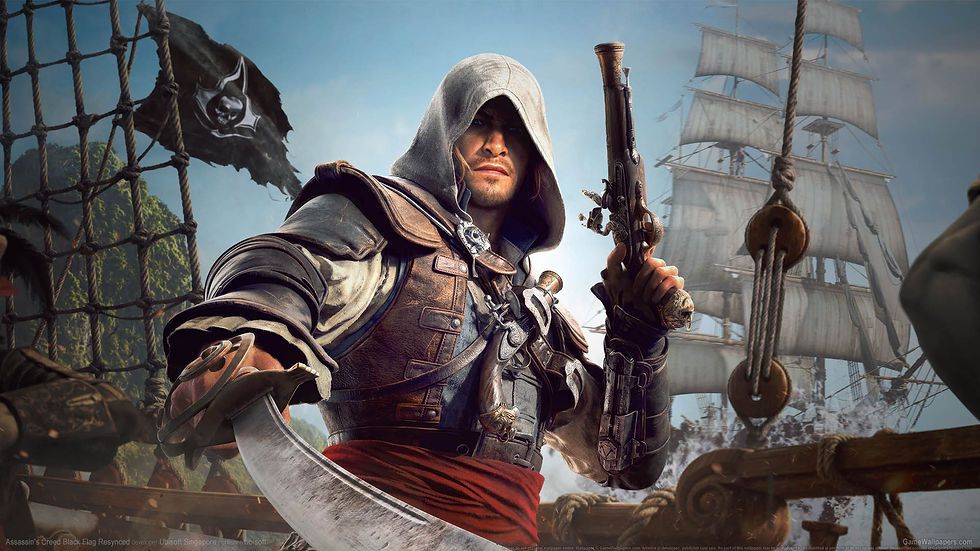
With today’s release of Black Flag - Resynced, the iconic and household game is once being infused with new life, almost 13 years after its original release. The remake intends to honour the greatness that the original laid the foundation for, all while introducing a new and fresh look at the game, further expanding the story, with new story elements and gameplay adjustments. A new generation of fans will get to experience one of the most iconic entries in the series, but this time with updated and modernised gameplay, as well as improved graphics built on technology, we simply did not have during the time of the original game’s launch. Resynced is a major first step for the long running Assassin’s Creed series, and a bold new beginning for a franchise almost two decades into its existence. The series may indeed be older, but the future has never looked brighter for Ubisoft and the fans.
Happy launch day, and make sure to also check out our written review of the game, and stay tuned on all our platforms for a variety of special Black Flag themed content in the coming weeks! Happy playing!

About the Author
Hayden is a passionate Freelance Writer based in South Carolina who joined TOWCB's Writing Team in 2020 during the Covid-19 Pandemic, writing articles on all things Assassin's Creed Valhalla. He left the group to focus on studies, joining our Alumni program, but triumphantly returned with fresh ideas in 2024 to pick up where he left off, only this time covering Assassin's Creed Shadows.
In 2025, Hayden took on the position of Team Leader for TOWCB's Writing Team, overseeing article releases, assisting with recruitment and providing assistance with internal operations.
Hayden Bird