

Assassin's Creed Brotherhood: Cesare Borgia and the Real History
Analysis
Ruthless, cunning, a military genius. Those are just three ways to describe Cesare Borgia in Assassins Creed: Brotherhood. But they can also describe the real Cesare Borgia. But who was he really, and was he quite as ruthless as Brotherhood’s antagonist?
Cesare Borgia was born at some point between September 1475 and 1476, though the general consensus puts his birth date as 13 September 1475, to Cardinal Rodrigo Borgia and Vanozza Cattanei. As a member of the Catholic Church Rodrigo had sworn a vow of celibacy, however it was an open secret that churchmen fathered bastard children. Everyone knew that Cesare was the son of Rodrigo, despite the fact that Vanozza was married and the child passed off as her husbands’. He was the oldest of a set of four - Lucrezia, Juan and Joffre. As the eldest child, by rights Cesare should have grown up to go into the military and marry into another noble family, but that path was chosen for his younger brother Juan - it certainly proved to be a point of contention between the brothers. Cesare ended up in the Church, becoming the Archbishop of Valencia when he was just 17 years old and then joining the College of Cardinals after his father became Pope. But even at a young age Cesare knew he was destined for more. He believed in the ideas of Fortuna and Virtu and Machiavalli later described him as believing “himself capable of accomplishing whatever he undertakes.”
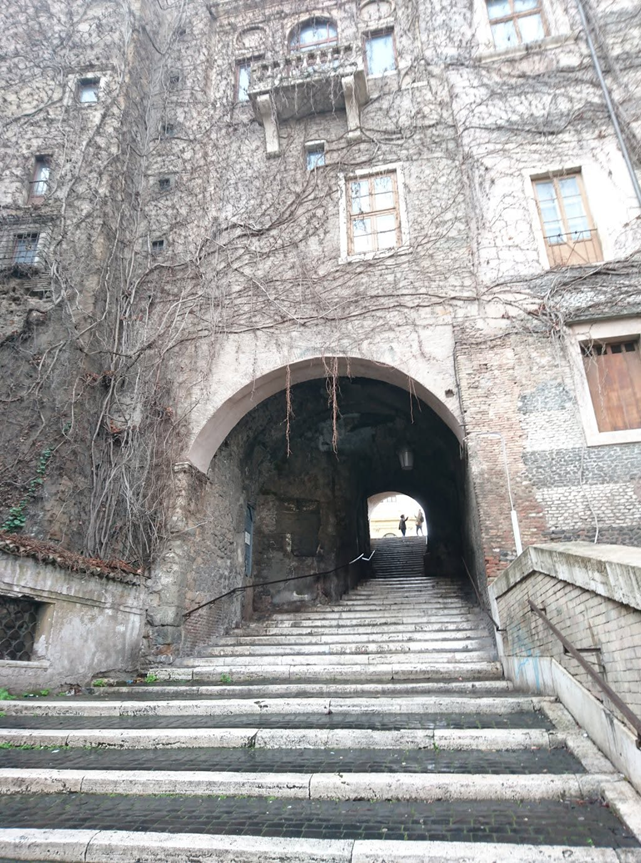
In the early stages of Assassins Creed: Brotherhood, after Ezio finds his way to Rome, Machiavelli mentions that Cesare Borgia killed his own brother. Now it’s a fact that Juan Borgia was murdered in 1497, and that Cesare was one of the suspects for it. But what really happened? On 14 June 1497, Cesare and Juan attended a party at their mother’s home, believed to be a property next to the church of San Pietro in Vincoli (St. Peter in Chains). The steps (the ‘Salita dei Borgia’) by the church are an iconic area in Rome and said to be the last place that Juan Borgia was seen alive. Cesare and Juan left the party together, along with a strange masked man who had been attending Juan that evening, but they soon split up. According to Juan he had some business of his own to take care of, which wasn’t exactly unusual behaviour for him. Little was said about the decision, only that Rome was dangerous at night so Juan shouldn’t go alone. Instead Juan sent his groom off to fetch his light armour, telling the boy to meet him shortly in Piazza Judea, before leaving with the masked man in tow. Cesare lingered a while with his uncle, the Cardinal Juan Borgia, as they were worried about the way the younger Borgia had left with the masked man. They hoped that he would come back and they could all return to the Vatican together, but when Juan did not show up they took themselves back to the Apostolic Palace. Accounts differ slightly here as to what happened with Juan’s groom - Scalona, the Mantuan Envoy, reported that the lad was attacked and mildly wounded. His wounds were not bad enough for him not to continue to the Piazza to await his master, but when Juan did not show up he returned to the Vatican thinking that Borgia had gotten sidetracked with one of his amours. Other accounts state that the groom was mortally wounded and died the next day.
The following day, Pope Alexander VI began to worry when his son did not return home despite the fact that the behaviour was not exactly unusual. But the worry only grew when Juan still had not returned by nightfall. The Pope panicked and ordered that the city be searched for his son. News came on the morning of 16 June 1497 when a timber dealer came forward and reported that he had seen three men dumping a body in the Tiber river the previous evening, When he was asked why he had not reported it straight away, the timber dealer stated that he often saw such things so did not think it very unusual at the time. The river was duly searched with a number of bodies being pulled up, until one caught their attention. It was Juan Borgia, Duke of Gandia. The young man was covered in wounds across his neck, body and legs but interestingly the purse on his belt was full of money. Clearly whoever had murdered him had no wish to rob him. The body was taken to the Castel Sant Angelo where it was swiftly prepared for burial, and then carried to the Borgia family chapel at the church of Santa Maria del Popolo where he was interred. His body still remains somewhere within, but nobody knows quite where as there are no surviving grave markers.
Mad with grief, Alexander locked himself away in his rooms and refused to eat or drink. An investigation was immediately launched in order to find the individuals who had murdered the Pope’s son - on Monday 19 June, Pope Alexander called a meeting of the consistory and formally announced his son’s death as well as absolving certain individuals from having anything to do with it: Included within that list was Giovanni Sforza (his daughters husband), Joffre Borgia and Guidobaldo da Montefeltro. A little over a week later, the search for the murderer was called off. But why? Had Alexander discovered who it was and wanted it kept quiet? It certainly felt that way to many and the people of Rome began to whisper. Interestingly, however, Cesare’s name was not mentioned. At least not to start with. It was only the following year that people began stating that it must have been Cesare who murdered his brother. After all, Cesare was jealous of Juan and wanted his military roles. The envy between Cesare and Juan was well known. Yet Cesare did not even benefit from his brother’s death until much later. More likely it was members of the Orsini family who had committed the deed, having a long standing enmity with Juan after he had embarrassed them during earlier military campaigns. In fact, the rumours that Cesare was involved began in Venice which was a town full to bursting of Orsini allies. As with everything connected to the Borgia family, the rumours stuck and even now there are those who say that Cesare Borgia was the one who murdered his brother.

What of Cesare’s relationship with his sister, Lucrezia? Within the game it is alluded to that they are closer than close, and this is a rumour that ran rife while they were still living. Many believed that the entire Borgia family committed incest, especially after Lucrezia’s annulment from her first husband, Giovanni Sforza, in 1497. The claim made against Sforza was that he was impotent so the marriage could not be consummated, which was a ridiculous claim considering as how his first wife had died while giving birth to his child. When he was asked to prove he was not impotent by sleeping with a courtesan in front of a group of cardinals, he refused. It was sealed. The marriage was annulled and Giovanni Sforza was embarrassed as an ‘impotent’ man. So incensed was he that he spat out that the only reason the Pope wanted the divorce to go through was so that he could have Lucrezia all to himself. Those words stuck and it was noted just how close the family were with each other. The people whispered - the Borgia family committed incest and Lucrezia was actively sleeping with her brother. It should be noted that there is no credible evidence that this ever happened - the reports come from biased sources with a hugely anti Borgia sentiment. Whether it truly happened or not we will never know for sure, but the evidence certainly suggests otherwise. In fact, during one of his final scenes with Lucrezia in Assassins Creed Brotherhood the two face off. Lucrezia cries out as he holds her against a wall that she is his Queen, only for him to spit, “You are my sister. Nothing more.” Could this be a nod towards the fact that the incest is all just a rumour?
Cesare Borgia’s death came on 12 March 1507, outside the town of Viana in the Kingdom of Navarre. At the end of Assassins Creed: Brotherhood we see Cesare and Ezio fighting atop the walls of town with Ezio eventually winning the day. The reality of it was very different. Following his father’s death in 1503 and the ascension of Pope Julius II (Guiliano della Roverre, who was an enemy of the Borgia), Cesare had been kept in captivity both at the hands of the new Pope in Rome and also the monarchs of Spain, Ferdinand and Isabella. Cesare, of course, made a daring escape from his cell at the fortress of La Mota in Spain and gravely injured himself in the process. But he still managed to make his way to Navarre where his brother in law, Jean d’Albret, was King. Despite the fact that Cesare had not seen his wife since they had first been married, he believed that Jean would help him. After recovering Cesare agreed to help Jean retake the town of Viana, which had fallen into the hands of a group of rebels, led by Luis de Beaumonte. Borgia took command of a large force of soldiers and rode to Viana and began to lay siege to the town and castle.
Unfortunately for Cesare, the weather turned. As a vicious storm broke he withdrew his troops to safety, only for a number of Beaumonte’s men to make a run for it. Of course Cesare was incensed at this - the siege was obviously ineffective if these soldiers had escaped, so Cesare and a band of men rode out after them. The storm was so bad that they got split up and Cesare was left alone, while the men rode back to town. He was ambushed, surrounded by the men who had escaped from the castle - as he raised his arm to attack one of the men pierced him with a spear and he fell, mortally wounded, from his horse. Despite the wound he fought on but was soon overwhelmed. Bleeding out, Cesare Borgia was stripped of his armour and left naked, with just a stone (some accounts say a red tile) to cover his modesty. So there was no fight atop the walls of Viana, only the son of Pope Alexander VI being ambushed whilst alone. The only similarity to Assassins Creed Brotherhood is that Ezio gradually removes pieces of Borgia’s armour. The men who had killed him had no idea that they had ended the life of Cesare Borgia and in fact they had been ordered not to kill him should they meet in the field of battle. It only became clear that Cesare Borgia was dead when his squire, Juanito, was shown his armour and the boy burst into tears. Borgia was buried within the church of Santa Maria in Viana, his tomb carved with a simple but fitting epitaph, “here in a scant piece of earth, lies he whom all the world feared’. In 1537, just a few years after his death, Cesare’s body was removed from the tomb as he was seen as evil and thus not worthy of being buried in consecrated ground. His bones were placed in front of the church where he was walked over for centuries, until he was reinterred inside the church in 2007.
These are just a few examples of the differences between the video game Cesare Borgia and his real life counterpart. There are certainly similarities between the two - both were excellent military men, cunning and manipulative. However much of the Brotherhood story draws more on the rumours that have surrounded the life of Cesare Borgia for hundreds of years. Still, the lurid tales make for a good story and Cesare Borgia proves to be the perfect antagonist for Ezio Auditore to deal with.

About the Author
Samantha Morris (Sam) is a historian and author who joined The Ones Who Came Before's Writing Team in September 2026.
Sam has always been interested in Renaissance history: the corruption, the art, the religion, the Borgia family, an interest which was fuelled even further by the Assassin's Creed series.
It was whilst studying archaeology at the University of Winchester where her interest in the history of the Italian Renaissance began. She is the author of 'Cesare and Lucrezia Borgia: Brother and Sister of History's Most Vilified Family' and 'The Pope's Greatest Adversary: Girolamo Savonarola'.
We can't wait to see Sam's historical articles, coming soon to the website!
Samantha Morris